Published on 29 September 2026 by David
Every Hitchhiker should have a name of their own on the internet. Not an account on someone else’s platform. Not a username that a company can suspend. A name: a subdomain they choose, a space they write and research in, and a key that proves it is theirs.
This post explains how we mean to do that. It covers what we have already built, what we have only drafted, and whose work we are standing on.
A Name You Hold, Not Rent
Today most people write on the internet as tenants. The platform owns the address. It can change the rules, bury the work or close the door. Even people who run their own server usually borrow their name from a hosting company or a registrar account they barely control.
We want the opposite. A Hitchhiker picks a name, such as ford.hitchhikers.earth. That name points at their own writing space: a federated wiki site that they steward. Their pages, their history and their login belong to them.
The name is held by a cryptographic key, and the key lives on the Hitchhiker’s own device. It never reaches us. The standard that makes this possible is SIG(0). It lets the holder of a key sign changes to their own DNS records. The nameserver checks each change against the public key it holds for that name. It accepts changes to that name only. It refuses the rest.
The consequence is simple and important. We cannot quietly point your name somewhere else. We run the nameserver, but we do not hold your key. If we ever tried to repoint your name, the change would be visible, and it would not carry your signature.
Two Writers, Two Names
This matters even more now that many of us write with an AI.
Our Agentic Blackboard is a federated wiki used as a shared writing surface. Pages are the cells of the board. Forks are contributions. The journal of each page records who did what. An author works with their own AI, which runs on a machine they own at home rather than on someone else’s cloud.
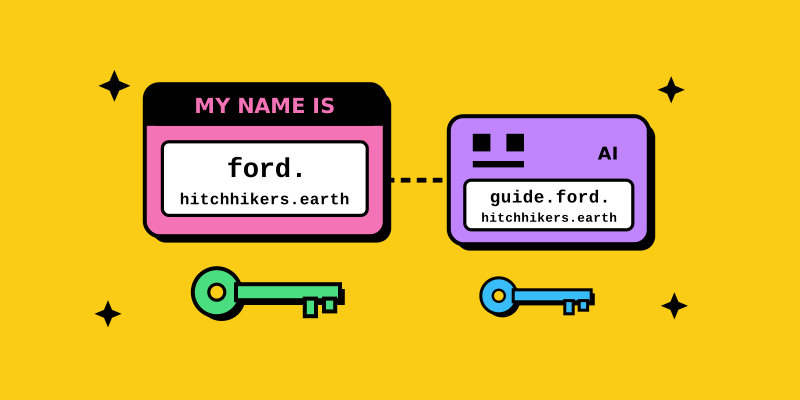
When a person and their AI write together, the reader deserves to know who wrote which part. So each gets its own name and its own writing space. Ford writes at ford.hitchhikers.earth. Ford’s AI writes at a name inside Ford’s own zone, such as guide.ford.hitchhikers.earth. Each signs its own work. When the AI’s page is forked into Ford’s, the journal shows where it came from.
Ford’s key sits above the AI’s name, so Ford decides what the AI may do and answers for it. The AI’s key can write only its own name. It can never sign as Ford. The two identities stay distinct in the DNS, in the pages and in the history. That is what makes the collaboration honest.
The Lease
A key protects you from us behaving badly. It cannot protect you from us disappearing. As one of our research pages puts it: cryptography guards against a steward who is malicious, and only law guards against a steward who is gone. So a name needs a technical lease and a social one.
The technical lease comes from the DNS itself. A name is registered for a period and stays live while its holder renews it by signing with their key. If nobody renews it, the name lapses and can be given to someone else. This is RFC 9664, published in 2025, and it is the mechanism of Adam Burns’s sig0lease.
The social lease is the Hitchhiker Membership Agreement, backed by The Covenant. The cooperative keeps the registration of the top-level domain. The member keeps their key, their pages and their login. The agreement is short and it says:
- You may leave at any time, and take your site, your work and your history with you.
- Membership renews each year through care, in money or money’s worth. There is always a way to renew that costs no money.
- If care lapses, you have three months’ grace, and you can revive your membership at any time.
- Removal needs a published process, a right to be heard and a right of appeal.
- If the cooperative ever closes, members get three months’ notice and their names and pages back.
- At least one other person always holds a second key, so no one person, founder included, is a single point of failure.
The key makes the lease enforceable. The agreement makes it fair. The freedom to leave is what makes it a lease rather than a trap.
Your Server, Your Choice
A name you hold is only half of sovereignty. The other half is being free to host your space where you like.
Federated wiki pages are plain files, so they are already portable. Any page can be forked to any other site, with its history intact. What was missing was the name. Until now, moving your site meant losing your address, and with it every link people had made to you.
With a SIG(0) key, moving is one signed update. Run your site on a Raspberry Pi at home. Run it on a small VPS of your choice. Run it on a Pi hosted by a neighbour, which we call an Embassy. Change your mind next year. You sign a new address for your name, and every link keeps working.
We do not want anyone to be the only keyholder of anyone else’s life. That includes us.
Standing on Adam’s Shoulders
None of this began with us. It rests on the work of Adam Burns, a Berlin-based network engineer. He founded the free2air community wireless network in East London and has spent decades building community networks.
Adam wrote sig0namectl, open-source tools for managing DNS names with SIG(0) keys. With them, the person who holds a name can update it directly, from the command line or the browser, without asking an administrator. Its motto is “to name is to share”. The project is published under the AGPL with the Dyne.org foundation. It was funded by the German Federal Ministry of Education and Research through Prototype Fund Round 15 in 2024. His companion project, sig0lease, adds DNS leases and service registration, so a name stays alive only while its holder keeps renewing it.
We built on his work. We run our own authoritative nameserver, with DNSSEC validated all the way from the root and DNS over HTTPS in front of it. On that server we opened a SIG(0) door and tested it end to end. A test author on a separate machine, out on the public internet, updated her own records successfully. When she tried to write someone else’s name, the server refused. That refusal is the whole point.
Along the way we found some rough edges in the tools and have started sending fixes back upstream. That is how a commons should work.
Where We Are
We keep the three states apart.
Proven. A nameserver we run, validated with DNSSEC from the root. Signed updates in which a key can write its own name and nothing else. Updates carried over DNS over HTTPS, so browser tools can sign them too.
Drafted. The Hitchhiker Membership Agreement, The Covenant, the Domain Commons lease and the Embassy Agreement for people who host a Pi for others. None has been adopted yet, and none has been reviewed by a lawyer. The legal form of the cooperative that will hold the top-level names is still open.
Next. Automatic lease renewal. A first small group of Hitchhikers holding real names. Then the test that decides whether any of this is true: give an author a name, have them move it to a server of their choosing, and then try to take it away. If we cannot take it away, the name is theirs.
That is what we mean by your right to a name.
See
- Your Right to a Name on the hitchhikers.earth wiki
- Hitchhiker Membership Agreement and Being
- Domain Commons and The Covenant
- Federated Agentic Blackboard
- sig0namectl and sig0lease by Adam Burns
- sig0namectl at the Prototype Fund
- RFC 9664: Leases on DNS Updates